
Skip to content

72% of companies say external disruption is significantly impacting their planning

BARC's new Spotlight report shows why static annual plans no longer work in volatile markets, and what future-ready, AI-enabled planning and performance management looks like. Get your free copy.

Static annual plans don't survive contact with a volatile market

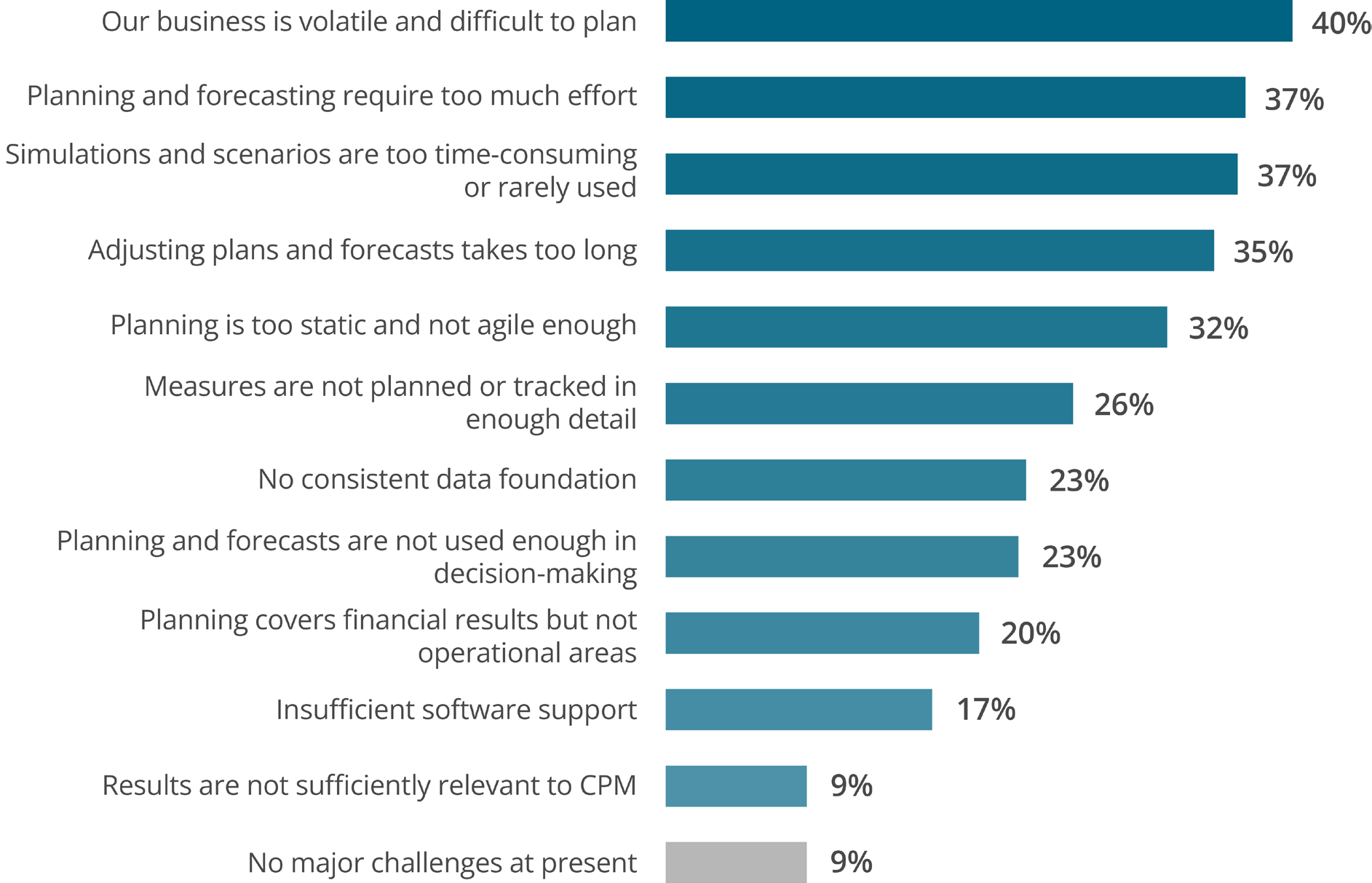
40% of companies say their business is volatile and difficult to plan. 37% say planning and forecasting take too much effort. Two-thirds still run part of their planning in Excel. BARC's Spotlight report explains why traditional planning breaks down, and what to do instead.

Executive Summary

“In volatile markets, planning must be continuous, integrated, scenario-based, and data-driven to support corporate performance management effectively. Anything else is like flying blind.”

— Dr. Christian Fuchs, Senior Analyst, BARC

What's inside the BARC Spotlight report

  • Why persistent volatility demands a new approach to planning
  • The four elements of future-ready planning: integrated, scenario-based, continuous, and data-driven
  • What to look for in a modern planning and performance management platform
  • BARC's six recommendations for volatile conditions:
    • Make the change a strategic priority
    • Invest in the data foundation
    • Integrate planning at every level
    • Make scenarios standard practice
    • Put AI to work
    • Work with experienced implementation partners
barc-chart-planning-challenges

Figure 1: What are the biggest challenges you currently face in planning and forecasting? (Source: BARC “Resilient Planning in Volatile Markets,” n=247)

Key findings

icon-seamless-integration

Integrated, not siloed

A consistent basis for decision-making requires end-to-end integration of strategy, budgeting, and forecasting, as well as financial and operational planning.

icon-intelligent-forecasting

Scenarios, not a single forecast

Simulations and scenario planning are central to resilient planning and performance management, but many companies have yet to make them standard practice.

icon-collaboration

Continuous, not periodic

Rolling forecasts and continuous planning need to replace rigid annual plans. Many companies see AI as an enabler of this change.

icon-problem-solving

Data-driven, not gut feel

High-quality data is a prerequisite for modern planning methods and effective use of AI.

How IBM Planning Analytics answers the findings

BARC's four findings describe what planning has to become. IBM Planning Analytics, recognized as a Market Leader in the BARC Score Integrated Planning & Analytics 2026, is how finance teams get there, implemented end to end by Intito.

  • One model for finance and operations

    Financial and operational planning for finance, operations, sales and HR run in one governed model, on shared master data and permissions

  • Scenarios inside the plan

    Scenarios are calculated in the same model as the plan, so a spike in commodity prices, a shrinking main market or the loss of a key supplier can be set directly against it.

  • AI that keeps the forecast current

    AI forecasting predicts outcomes and highlights trends, and AI agents take repetitive work out of every planning cycle

  • Data you can trust

    Real-time access to your most important data, with outlier detection that flags values that are too high, too low or missing.

Your teams keep working in Excel if they want to, and you choose where it runs: on-premises, hybrid or SaaS.

"With IBM Planning Analytics, we have reduced the time it takes to generate reports from 7 days to just a few seconds. Our productivity has increased by 85%!"

— Alexander Beil, HR Controller, Volkswagen Group Services

Explore IBM Planning Analytics

Get your copy of the BARC Spotlight report

See the full data, the four elements of future-ready planning, and BARC's six recommendations for planning in volatile markets, with Intito's perspective on putting it into practice.

Get the BARC Spotlight report